

A Curandero in the upper Ucayali sits across from a patient and starts to whistle. Barely audible — more breath than tone. This is silbando, the near-silent delivery, and at that volume the icaro does its strongest work. The whisper carries the medicine.
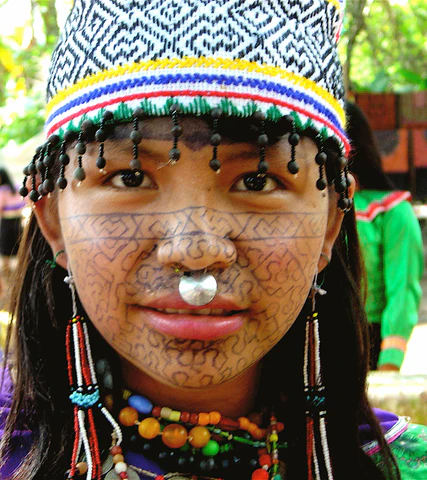
The portrait holds a singer mid-ceremony, the moment the whisper becomes visible. A face surfaces in him, but the lines do not stop at the brow or the jaw. The same labyrinthine geometry that flows across the maiti headband runs unbroken across his skin, his ornaments, and the lattice around his head. The face surfaces through subtle shifts in line direction. The body is absorbed into kené, the Shipibo visual language that transcribes song into pattern.

Kené operates as a script. Shipibo artisans paint it onto pottery, embroider it into textiles, lay it across the body, and carve it into ceremony benches, and in each location it carries the same correspondence — geometry standing in for melody. Late 20th century anthropologists working in the Ucayali documented this link as stable and consistent across communities: a singer can sing a textile, and a maker can paint a song. A shaman reading a cloth listens to the lines. The portrait shows what listening looks like from the inside.
Around the head, stepped crosses and right-angled maze paths hang like a textile pulled across the upper field. This is what an icaro becomes when it has been called into the room and held in place. The lattice is arkana — protective pattern thrown like armor around the singer and the one being sung to. The shaman has become part of what the textile is made of.
Pablo César Amaringo Shuna spent decades after he left curandero practice painting the visionary field he had moved through during ceremony. His canvases from Pucallpa are dense with cosmologies — spirits, vines, animal beings, geometric arkanas hung across the upper register. In his paintings the luminous patterns and the icaros are the same substance, one heard and one seen. The portrait belongs to that lineage, pulled in close — Amaringo gave the entire world, and here a single face dissolves into it.
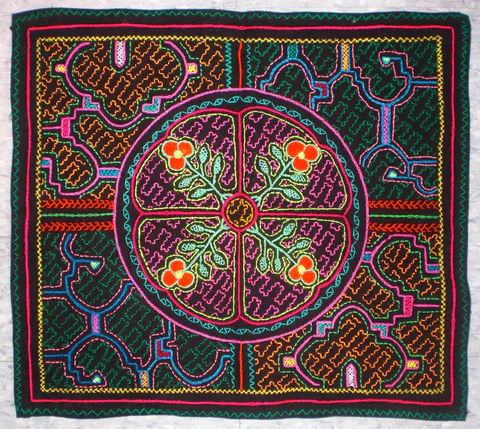
The vine called Banisteriopsis caapi carries the songs. The chakruna leaf — Psychotria viridis — carries the visions. The two are drunk together, and the icaros learned in ceremony are said to belong to those plants, with the singer carrying them only after they have been given. Onaya learn melody first. The tune arrives, sometimes for years, before the words come down. The chakruna leaves uncoil from behind the medallions at jaw and chest, feathered and elongated, the only soft edges in the piece. They belong to the singer the same way the arkana around his head belongs to him — flesh and song and plant continuous with one another.

A trained onaya carries hundreds of icaros in memory. Healing songs. Diagnostic songs. Songs to call particular plants. Osanti — the laughing songs — sung from the point of view of non-human beings, jaguars and forest spirits and small animals who find something amusing about humans that humans cannot see themselves. Bewa, besho, the various Shipibo names for the medicine song. To carry hundreds of these is to carry hundreds of geometric patterns, each one folded into a melody. The lattice over the head is one of them, called into shape and held there for as long as the breath holds.

There is a Shipibo concept of mariri — a magical phlegm stored in the chest of the curandero, materialized shamanic knowledge that thickens with years of practice. The mariri allows the singer to draw a sickness out of a patient and hold it without being harmed. The portrait places two large circular medallions at jaw and chest. Inside each, kené geometry concentrates into a focal disk, a mandala folded tight. The chest medallion sits where the song is held; the pectoral hanging below it, woven and fringed, marks the same spot the singer would tap to call up what's stored there.
The symbolika art work shamanico renders the singer as a symbol of his own song. Eyes open, looking out, head and shoulders squared, no body action — meditative because the song is what moves while the singer stays still. The arkana fills the field around him because the icaro is traveling outward. The medallions glow because that is the origin.
The strangeness of the practice is that the patient sees none of this. The patient lies in the dark, sometimes drinks the brew, sometimes does not. The shaman sits a few feet away and whistles. The kené arrives as sound and lands on the patient's body as pattern — that is the claim made by every onaya who has explained the work to outsiders. The geometry travels by voice. The portrait holds the moment that travel becomes visible, when singer and song and lattice are no longer separable.
The figure stops being a figure the longer the eyes rest on it. The gaze still meets yours, but the boundary between what is him and what surrounds him gives way. The singer is inside the song he is singing. The song has a shape. The shape has a body. The body is him.


About the Artwork
A face surfaces and dissolves back into itself. The lines that build the features never stop — they run unbroken across skin, ornament, and the geometric lattice haloing the head, so the eyes meet yours but the boundary keeps giving way. You are watching someone become the song he is singing. The stepped crosses and maze-paths hang like protective textile above, and the longer you look the less you can separate the singer from the pattern surrounding him. The symbolika art work shamanico makes dissolution visible, the moment a body and the ceremony it is holding become continuous.


