

You wake up and the argument starts before your feet hit the floor. The body wants more sleep, the calendar wants discipline. You want the silence of an empty hour. You want the second coffee. You want to renounce. You want to enjoy. Same person, opposite directions, 6 a.m.
Sanskrit had words for this fight long before the fight had a name in any language you speak. Yoga), the path of yoking, of pulling the senses inward toward something steady. Bhoga, the path of enjoyment, of taste, of sinking into the world's textures. The monk and the merchant. The fasting saint and the feasting king. Most spiritual traditions ask you to pick one and stay picked.

Indian philosophy spent centuries on the argument. The Charvaka materialists made the case for bhoga: eat, drink, live, the body is the whole story. The forest renunciates made the case for yoga: starve the senses until what remains is signal. Bhartrihari, a 5th century king and poet, reportedly cycled between the two paths 7 times, walking out of his palace to become a monk, then walking back to become a king. He wrote his most famous verses about both states, treating his own indecision as the material.
The figure who answered differently
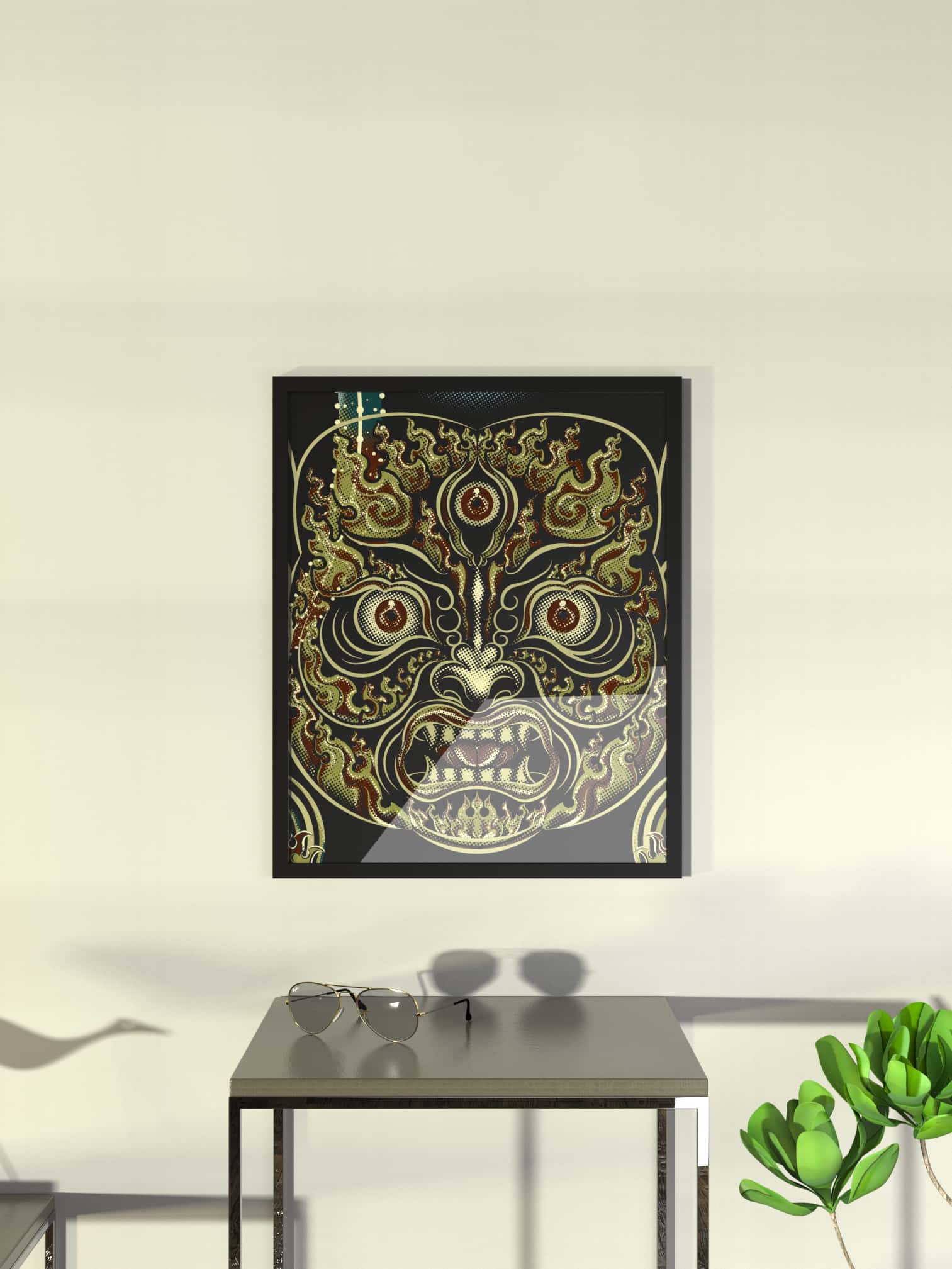
The deity at the center of this image answered the question by becoming the question. The same figure mirrored outward, duplicated on every side. The body composed of fire patterns and water patterns at the same time, the two elements running through one another instead of holding separate corners. The face splits down the middle: one half placid, one half blazing. Same head, two states.
This is the Kalachakra stance. Kala means time, chakra means wheel. In Tibetan Buddhist tradition, Kalachakra teachings sit among the most elaborate in the entire canon, running across initiations that take weeks to transmit and texts that read like cosmic engineering manuals. The core idea is direct even when the ritual surface is dense. Reality holds opposites at the same time. Practice means learning to stand inside that simultaneity without flinching.

The stitching together of yoga and bhoga has a name: Tantra. The Tantric traditions that flourished across India and Tibet from roughly the 6th century onward argued that the body, the senses, and the world were themselves the vehicles to liberation, the raw material of awakening. The deity in front of you is what that argument looks like when it stops being theory and takes a body.
Most deities ask you to become something. This one asks you to stop splitting.

The wheel
The wheel in the figure's hands works as an infinite mirror. Turn it one way and you see desire. Turn it again and you see discipline. Both views hold their force. Both views keep being true at the same time. Yoga bhoga becomes a single position: both paths held in one body, both faces showing at once.
Kalachakra teachings describe 3 wheels turning at once. The outer wheel of the cosmos, planets and seasons and time itself. The inner wheel of the body, breath and blood and the channels they run through. The alternate wheel of practice, the one you can actually touch. Each turn of one moves the others. The figure in the image holds all 3 in the same hand.


The elements around the figure carry the same message in a different register. The lotus at the base is earth. The curling tendrils are fire. The wave forms are water. The clouds in the upper bands come from Himalayan tangka painting, where they mark the threshold between the visible world and what moves behind it. Together they form a cosmogram, a working map of how the elements move through each other rather than at each other.
The skull pendants are a Tantric signature. In Hindu and Buddhist tantra, the skull is the reminder that nothing escapes the wheel. The king eats. The ascetic fasts. Both end up inside the same skull. The wheel keeps turning, indifferent to your strategy.
The wheel maps every duality you carry. Pleasure and restraint. Action and stillness. The part of you that wants to break a fast and the part that scheduled it. Each rotation shows you a face of yourself you would rather skip. The practice is to keep turning anyway.
The deity already knows you will lose half the arguments you have with yourself. The deity already knows you will be a renunciate on Tuesday and a hedonist on Saturday. The Kalachakra position skips the promise of resolution. It says the contradiction itself is the territory, and the wheel is how you walk it.
Sinking into the world's textures
About the Artwork
The same deity reflected infinitely, the same image returning on every duplication. A single face split down the center into dual expressions, fierce and placid sharing one head, arms flung into cosmological rings flanked by sun and moon. This is Kalachakra, the deity who holds both paths in the same body: discipline and pleasure, withdrawal and feast. Yoga and bhoga — union and enjoyment — carried in one breath. The wheel turns without resolving. The contradiction is the resolution. YogaBhogha.


