

She sits with eyes lowered, head bowed slightly, and from her solar plexus a fine line draws outward into the air. The line is also a serpent. The serpent's tail is also a small chacruna sprig. Thread, snake, leaf — a single continuous form, pulled from her chest as if song were being spun into fiber.
The serpent's open mouth rests at her sternum. Its tongue points where the line begins. Her shoulders stay loose, her breath quiet. She lets the creature wrapped around her ribs speak through her hands. Receiving the Song
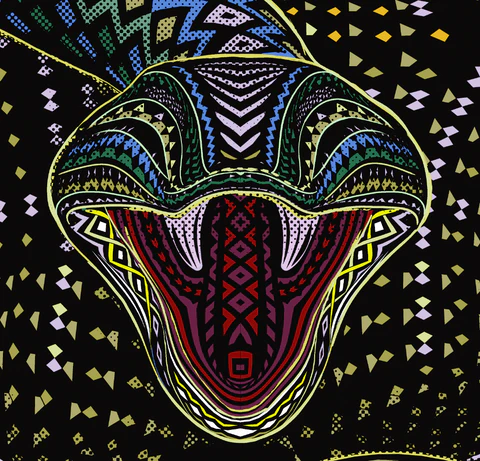
In Shipibo practice the song is given. The word for it is icaro, and the word for the giver is rao — the spirit of a plant, communicating through visions and through a melody that the human throat then has to carry into the room. The singer is a conduit.

A Pattern That Is a Voice
The chacruna leaf at the end of the line is doing real chemical work. Chacruna carries N,N-dimethyltryptamine, a visionary compound the gut breaks down before it ever reaches the brain. Brewed together with a vine carrying monoamine oxidase inhibitors, the chemistry holds together long enough for the compound to cross. The plant in her hand is the second half of that equation, and the vision that follows is what becomes the geometry around her.

Guillermo Arévalo, a Shipibo healer who has spent decades teaching this material to outsiders, puts it plainly: the patterns come from elsewhere. The geometric language called kené — the dense lattice of lines, diamonds, and rosettes covering Shipibo textiles, ceramics, and skin — comes from the plant spirits. The healer sees the pattern during ceremony. The hand reproduces it afterward, in thread or in clay or along the cheek. The source is what the rao showed.
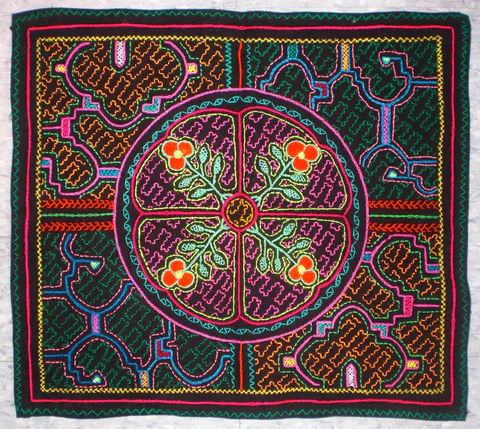
That's why kené keeps the same vocabulary across centuries. The pattern is being copied.
The Cloth and the Ground Are the Same Cloth
The patterning travels everywhere. It covers her skin. It covers the serpent's scales. It covers her garment. It covers the blanket spread across her lap. The blanket doesn't stop at her knees — its lines flow down and forward and become the rippling ground she sits on. The same lines fan outward into the surrounding aureole of stars and small rosettes.
What she's weaving is the floor and the sky.
Shipibo cosmology has a name for the original weaver. The anaconda — the great river snake — is the source of kené. Every pattern in the world is a fragment of the design on its body. To weave kené is to copy a section of the anaconda's skin into the human plane. The serpent coiled around her shoulders is provenance — the design handed to her scale by scale, her hands forwarding it into the cloth, the cloth forwarding it into the ground, the ground forwarding it into the stars.
This is the vision the title Song Weaving names. The song is the design. The design is the cloth. The cloth is the world.


What the Eye Could Hear
In the 1980s the anthropologist Angelika Gebhart-Sayer spent long stretches with Shipibo healers and came back with a finding still reprinted in every serious survey of the culture: the geometric designs and the healing songs are the same thing in 2 media. A healer could look at a patterned textile and hum the song that matched it. A healer could listen to a song and draw the pattern. Sight and sound were translations of a single underlying score.
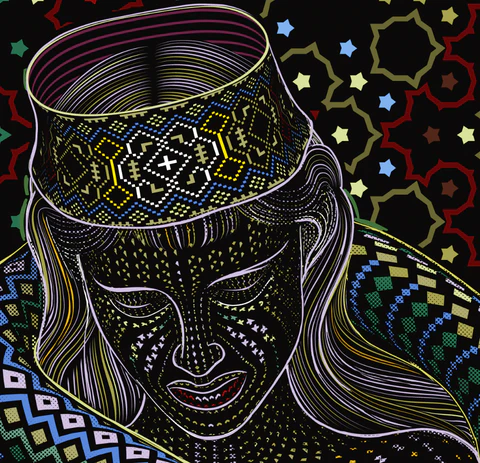
That gives the picture its inner mechanism. The line coming out of her chest is the literal claim of the cosmology — a song, sung correctly, leaves a visible track. The track is geometry. The geometry can be sewn. The sewing is the song made permanent.
With that mechanism taken seriously, the stars and rosettes ringing her stop looking like decoration. They are the latest stitches. The song is still going. The world is still being added to.
About the Artwork
She sits in trance and draws a line from her chest that is also a serpent, also a chakruna plant — song pulled into form. The pattern covering her skin flows without break into the creature coiled around her, into the cloth across her lap, into the ground beneath, into the stars beyond. What she receives as melody leaves a visible track. Song Weaving names the union: when the singer becomes the stitch, when the thread in her hand and the floor beneath turn out to be the same cloth, still being sung.


